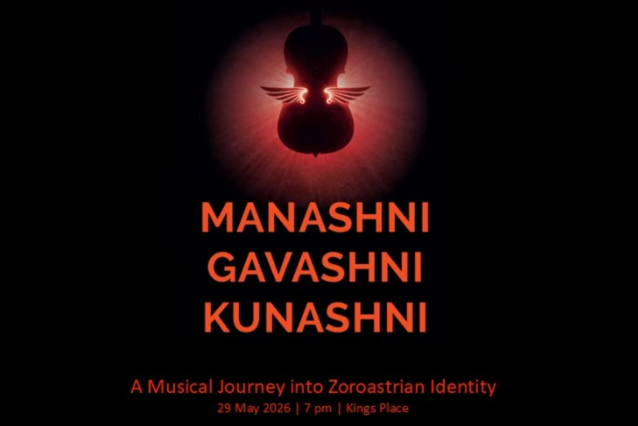
Jonathan Galton held the second Shapoorji Pallonji Artist-in-Residence fellowship (2025/26), which culminated in a beautiful musical evening on 29 May 2026 at Kings Place, London:
Manashni, Gavashni, Kunashni
A musical journey into Zoroastrian identity
The Artist in Residence Fellowship at the SOAS Shapoorji Pallonji Institute of Zoroastrian Studies (SSPIZS) is Mariano Errichiello’s innovation. As Co-Chair, Executive Director, and the driving force behind Jonathan’s residency, Mariano writes in the concert brochure (see the PDF at the end of this post) that the core academic question was how music has shaped Zoroastrian identity.
With the exception of The Banner of Kaveh—a spoken-word piece accompanied by Fra Rustumji on the viola—the music in the first part of the evening was not Zoroastrian, though performed mostly by Parsi artists. Here, it was at times difficult to see the Zoroastrian character in the compositions and performances.
The second part is perhaps best described as a musical cadence towards the question of what constitutes music and musicality in Zoroastrianism. This section opened with a conversation between Jonathan, the resident artist, and Raiomond Mirza—a Parsi musician and composer whom I had never had the pleasure of meeting, but who played a crucial role at the start of my own academic life. The illuminating conversation was followed by Raiomond’s composition based on the Ashem Vohu prayer, which was in turn followed by Prayer, a piece inspired by the same prayer and performed by Fra Rustumji and Jonathan Galton (as Jonathan humorously assured us, no post-colonial rules were harmed in the making of the piece). The performances concluded with the world premiere of Manashni, Gavashni, Kunashni, composed by Kahan Taraporevala, before ending with an audience rendition of Queen’s Bohemian Rhapsody.
Organised by a British artist and academic—Jonathan is a lecturer in sociology at UCL—this concert evening constituted a collaborative approach to Zoroastrian and Parsi musical and stage art, rather than an exploration of Parsi or Zoroastrian music itself. This is not a criticism. Zoroastrianism, in both its Iranian and Parsi varieties, has historically been reluctant to embrace and develop traceable artistic traditions. This is not to deny the existence of Zoroastrian art or artists, but is rather an assessment of the religion’s hesitance to develop distinctly artistic expressions of religious devotion.
There may be various reasons for this. One could argue, for instance, that Iran’s courtly music, commonly referred to as traditional Iranian music (موسیقی سنتی), preserves vestiges of pre-Islamic music, which in turn can be argued to be Zoroastrian—though I prefer ‘Iranian’. Farhad Fakhreddini‘s musical engagement with this tradition stands out. Alternatively, one could view those vestiges as remnants or post-Sasanian romanticisations of pre-Islamic Iranian music. Yet another alternative is to look towards Iranian chants of the holy prayers, or to examine music among Zoroastrians living in more rural settings and their performances at ritual gatherings. Be that as it may, if we leave aside liturgical chanting and the melodic recitation of prayers by individual priests, Zoroastrianism as it is practised today is often seen as lacking a distinct musical tradition.
Here, Jonathan took a different route from his predecessor, Karl Singporewala, who interpreted and engaged with his own heritage in free form rather than through an exploration of traditional arts. Jonathan chose to examine the lack of a musical tradition among—and here one must specify—the Parsis, in his conversation with Raiomond Mirza. This is not to claim that Iranian Zoroastrians possess a complete musical culture of their own; it is simply a corrective to note that the evening mostly focused on Parsi traditions.
Jonathan Galton, Mariano Errichiello and the SOAS Shapoorji Pallonji Institute of Zoroastrian Studies are all to be congratulated on this courageous undertaking. Who is to say what Zoroastrian music is to be? I can define Yazdi Zoroastrian music through specific examples, but this is London in 2026. It is a new dawn, perhaps even the opening dawn of Nietzsche’s Thus Spake Zarathustra, a work referenced during the concert. This time, though, without the problematic racial notions associated with it in the past. This was a musical evening by young Parsi musicians and composers, with music written for their own generation.
Let us capture the names of those who carried the evening so wonderfully with their voice, wit and the sound of their instruments (in the order of the brochure): Nina Wadia OBE, Kahan Taraporevala, Ervad Frazan Adil Kotwal, Fra Rustumji, Firoze Madon, Amir Massoumian, Raiomond Mirza, Natasha Dalal Lord, and the Ava Choir. And with this, perhaps we can also bestow the xwarrah of Iranianness on Jonathan for creating a musical evening in collaboration with musicians from the cultural sphere of Zoroastrianism.
We should not forget that Zoroastrianism is a young religion. Its three and a half millennia are just a start, a prelude to many more to come, in which the Good Religion will have to define and redefine itself many times over. Zoroastrianism was born in Asia, matured in Iran, and thrived in India; perhaps its future now lies on a global stage as a religion for the ages. The various groups of young Zoroastrians with whom I interacted over the past months will forge new paths into a broader future we should all look forward to: one built collaboratively by Parsis and Iranians, whether Zoroastrian or not.