As scholars studying Zoroastrianism, we must ask this question more often: What is the subject of our academic gaze, and whose is the subject of our study? We must ask, not to confront, but to challenge ourselves and our enquiries. We must ask and debate, lest our tools become blunt and rusty.
Brought up in a philological tradition and working on antique and late antique contexts, I am not convinced that we ask these types of questions often enough in our discipline. As a happy philologist, I find that we are taught to interrogate the texts far more than the nature of our own inquisitiveness. If philosophers can write about The Failures of Philosophy, why should we not be more watchful? After all, most institutions have a watchdog. Unlike others, however, we are in the best position to investigate ourselves, to critique our approach, and to push boundaries.1
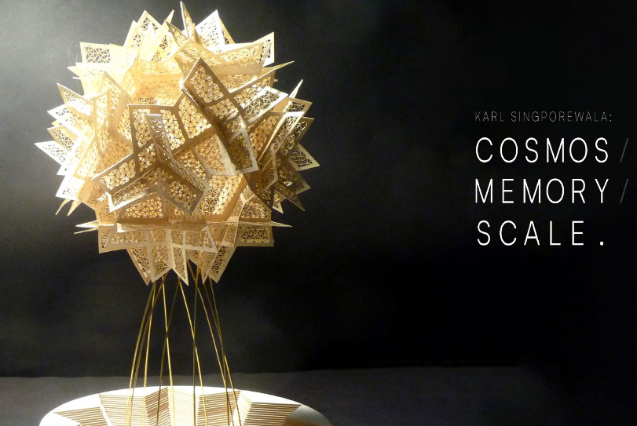
The impetus for this very brief rumination on my own trade is the exhibition Cosmos, Memory, Scale by Karl Singporewala hosted at the SOAS Gallery, which describes it:
The 2025 SOAS Artist-in-Residence Fellowship of the Shapoorji Pallonji Institute of Zoroastrian Studies presents a new major solo exhibition of Karl Singporewala’s sculptural interpretations of Zoroastrian symbolism. The exhibition features large-scale installations and new and past artworks from his catalogue which explore his heritage through art and architectural form. It will also showcase historic objects on loan from cultural institutions and private collectors.
The description is certainly accurate. Confronted with the artworks—not massive when we stand before them, yet immense once we consider the tiny figurines representing humans built into each piece—I found myself encouraged to reflect on my own place and position in the stream of the tradition I study. Karl’s interpretations of his own heritage challenge us to think in novel ways about what we do as scholars, and more specifically as philologists! The challenge is not explicit! It emerges from the synergy of Karl’s art and the location of the exhibition. SOAS, as a university, has contributed more than any other institution to the study of Zoroastrianism in the past century and continues to do so. The achievement of both Karl and the exhibition is to reflect on Zoroastrianism outside of the scholarly approach, yet present the result within an academic setting. Karl’s work made me realise what I should already know (but perhaps only pretend to know): Zoroastrianism is a living and lived religion, continuously re-interpreted, lived and owned by its followers. The exhibition clearly demonstrates that no religion consists solely of textual or practised theology. Each religion is a cultural tradition and an important part of an identity, even if one is not practising the Good Religion. These reflections might sound benign or even banal to some readers, but in Zoroastrianism, and still more among the philologists of Zoroastrianism, we too easily forget these dimensions of a religious tradition.
I was delighted to to meet Karl after taking a quick tour of the exhibition with Mariano. I felt humbled by his approach to Zoroastrianism. His art speaks through a manner of simplicity that reaches the observer without recourse to grandeur as an intermediary. For me, Fire Worshipper, a piece from 2025, exemplifies Karl’s directness and playful incisiveness best:

A catalogue, with a piece by Mariano Errichiello, places the exhibition in a broader context. The yet larger context is that the Artist-in-Residence Fellowship of the Shapoorji Pallonji Institute of Zoroastrian Studies continues with Jonathan Galton, who will bring musical interpretations to the study of Zoroastrianism. I am much looking forward to his work as well. And I hope that these fellowships continue not only as artistic endeavours but also as contributions that challenge scholarly convictions.
- I have previously reflected on the scope of the philological enquiry and methodology in Towards a Manifesto for Middle Iranian Philology (2023). In a lecture entitled Forgetting and Over-Remembering Iran, delivered in January 2024 at the Institute of Iranian Studies, Freie Universität Berlin, I extended these questions to Walter Benjamin’s approach to history (paper forthcoming). I will close the cycle with a forthcoming lecture that examines similar questions within a field of tensions shaped by the forces of Husserl, Heidegger, José Ortega y Gasset, Lakoff and Harman. ↩︎


