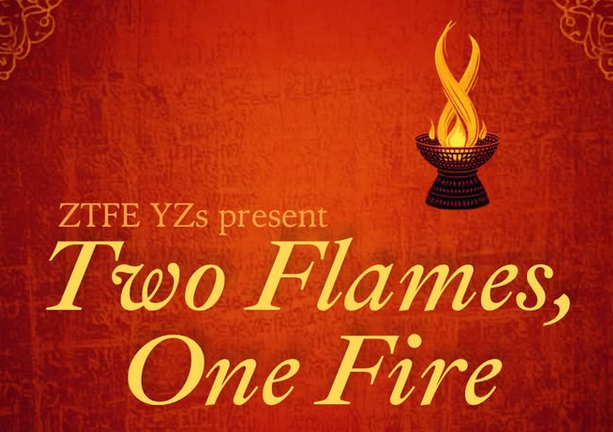
I joined Instagram in late May, following a visit to the ASHA Centre, where I had met a group of young Zoroastrians of diverse views and backgrounds. Shortly after I came across an account endorsed by the ZTFE (Zoroastrian Trust Funds of Europe) named ‘Two Flames, One Fire’. It had started posting in mid-May, promising an event in the near future without revealing much about it. At the time, most of the hashtags below the posts were unfamiliar to me, meaning, I did not yet know how to read #youngzoroastrians, #ukyzs or #yzs.
As details were gradually released by the account, the scope and themes of the event started to become clear, moving towards the account’s motto: ‘Bringing together the UK Parsi and Iranian Zoroastrian communities’ — perhaps through a business networking fair coupled with a fashion show. When they asked for volunteers to participate in a fashion show, vanity took hold of my otherwise cerebral identity; I admit that I spent some time in front of a mirror trying to imagine myself in a dugli, the traditional attire for Parsi men. How exciting! The perfect opportunity to wear one without cultural appropriation. (Please let me know if you know an app that allows you to view yourself in a virtual dugli!) This must have been a premonition of the ‘Dugli Dudes’, who offered some of the cheekiest moves to enthusiastic cheers and support from the audience. By this time, Kainaz Contractor, the organiser of the event, had, I imagine, captured the imagination of the ‘ZoroVerse’, to borrow the terminology of a Zoroastrianism-themed podcast.
The final event, though, held on 3 October, went beyond all my expectations. The evening opened with Mobedyar Mahshad Khosraviani and Kamand Faramarzi as the hosts, entering the stage to an Iranian song, setting the course of the night for many more surprises. As the evening progressed, we witnessed poetry composed by Kainaz; songs sung by community members; a humorous and heartfelt narration in two voices—Parsi by Faramarzi and Iranian by the expectant Khosraviani—of the most recognisable parenting habits (familiar to all of us); a narrative of home, migration and longing; a British pub quiz that the table where I sat should have won but did not; a fashion show highlighting various community, ethnic and historical clothing; a display of royal grandeur; and finally, the aforementioned roguish group called ‘Dugli Dudes’ dancing on stage and among the audience.


Before continuing, I would like to share a few questions I asked Kainaz:
Where did the idea for this event come from?
The idea for the event came from conversations surrounding the cultural gap and differences between Iranian and Parsi Zoroastrians, as well as the desire to educate the community on our cultural attire through a fashion show.
I had organised a few similar cultural events and multicultural fashion shows in my first two years at University (University of York, studying BA Business of the Creative Industries). Within these events, I wished that there was more Zoroastrian representation outside of myself, and decided to curate the ‘Two Flames, One Fire’ event in a similar format to showcase our own community.
Do you feel there is a need to bring the two communities together?
I definitely feel that the two communities should be brought together more. Growing up in the Zoroastrian Centre, I was taught a lot regarding the religion, but not much about Iranian vs Parsi traditions and culture – mainly because not many Iranians would be present. I believe over recent years, there has been an increasing amount of Iranian Zoroastrians attending events in the centre, but I do still feel that they are underrepresented. Bringing the communities together through ‘Two Flames, One Fire’ allowed me to explore the similarities and differences between the cultures and diasporas – from cuisine and language to religious festivals like Mehregan.
Did you organise the event mostly yourself? To what extent were the UK.YZs involved in the conception or planning stages?
I led the organisation of the event, curating the programme, writing the eponymous poem and even liaising with the WZCC and other contacts for the entrepreneurial and creative showcase. There were a variety of community members who helped the programme to take place – from the ZTFE managing committee assisting with the logistical and financial operations (e.g., subsidising new spotlights for the centre), to the performers (who even helped to set up the decoration at the centre after the dress rehearsal), and my family members too. The UK YZs showed support in the closer lead up to the event also, offering backstage help and support.
Sentimental question: What does Iran mean to you?
Iran to me is a hiraeth – a place that I have never been, yet feel oddly nostalgic about, and somewhere I yearn to visit. I have grown up learning of great Persian Kings and cities like Persepolis, and the more I read about Iran and Ancient Persia, the more I feel a connection to it.
On an adjacent note, I have more recently been more interested in pre-revolutionary Iranian Cinema specifically, which I am hoping to make my upcoming dissertation subject as I finish my undergraduate degree!
Kainaz also commented that she had ‘learned a lot about Iranian cultural clothing and the differences between clothing in different eras through the event planning!’. In saying so, she identifies an important cultural shortcoming among Iranians of all backgrounds: namely, that we often do not wear our traditional attire when attending events such as Navroze—in sharp contrast to Parsi, Indian and other Zoroastrian customs.


At no event, Zoroastrian or otherwise, have I seen such a joyful and effortlessly balanced programme. A week later, I still feel a ray of warmth when remembering the Iranian and Indian music, including a performance of کیش مهر accompanied by daf—not to mention the comedic highlight, which was undoubtedly the ‘Dugli Dudes’.
The evening was not about framing the community solely as religion; nor was it about framing a living, lived tradition in terms of academic supremacy of one ancient or late antique text over another. This was a community celebrating itself and its unity through its legacies and divergences. It painted in wonderfully subtle colours the many facets of religion as cultural identity, a unifying factor that reached far beyond just Parsi, Irani or Zoroastrian labels. At the same time, the two flames painted, in bright and bold colours, an affirmative vision of a future community growing beyond and defining its own borders.
At the event, a number of Persian poems demanded immediate attention. But before I launch into a recitation, one line by Amir-Houshang Ebtehaj—which I cite on every possible occasion—feels particularly relevant and inspirational:
آبی که بر آسود زمینش بخورد زود
دریا شود آن رود که پیوسته روان است
The water that rests is swiftly swallowed by the ground,
that river becomes the sea, that flows without cease.
For me, there was another lesson here too: be it Sanaya of the WZYLF, or Kainaz, be it the moderators of the programme, or many of the owners and managers of the businesses showcased, women were at the centre, actively participating, leading and shaping the identity of the community. This is no surprise; merely an observation that those who were not present ought to note.
And if I may say, ‘Two Flames, One Fire’ encapsulates, in the best way possible, the simple affirmation that each Zoroastrian speaks several times a day and ought to live:
xšnaōϑra. ahurahe. mazdā̊.
For the satisfaction of Ahura Mazda!
How you model the strife (kōxšišn) for the satisfaction of Ohrmazd is up to the individual, as long as it remains a celebration of this, our life on this earth (gētīy).
Heartfelt congratulations to Kainaz for her vision. May there be more! Congratulations also to the ZTFE for enabling and supporting this event; to the hosts for the warmth and joy of the evening; to the participants for their performances; and to the community for their joie de vivre. Special thanks go to Nawaz, who always radiates warmth and wisdom, for baking 380 cake yazdi (کیک یزدی) that brought back memories of childhood escapades in Tehran with one of my favourite baked goods.
Addendum: Speaking of Tehran
I recently brought tears to the eyes of two Parsi friends simply by talking to them about Iran. Asking one if she had ever been to Iran made her visibly emotional; with the other, sharing Iranian music evoked a similar response. Kainaz’s answer is not far off. Having reached the end of this blog, let us take a moment without too many words to reflect on what home means to all of us, and how we share that ‘longing’ and ‘yearning’ (used by my friends) for a part of ourselves we seem to have left behind: whether we departed a millennium ago or only recently. Iran is one of the first things we pack when we leave, be it in the shape of a rosewater sprinkler and Mount Hara, or a handful of earth (خاک) that we protect like gold dust.
I promise never to ask a Parsi about Iran again, and to fight my tears if you cry.
Leave a Reply
You must be logged in to post a comment.