An Oriental-adjacent friend recently told me that I could be mistaken by Europeans for an emotional Oriental. It was advice; perhaps a bit of a warning, or both. I readily admit that I have emotions, and I cannot help it, as it is in my genes. I do not know if Oriental men have more active tear glands, but I do come from a family whose men carry their tears in their sleeves, and that on both sides. My grandfather used to recite poetry—mostly to me, as I was the only other tear-gland Oriental in the family—and tear up. I am unsure whether this is what that well-meaning friend was trying to communicate, but there you have it: I am an emotional Oriental. I react the same way to music.
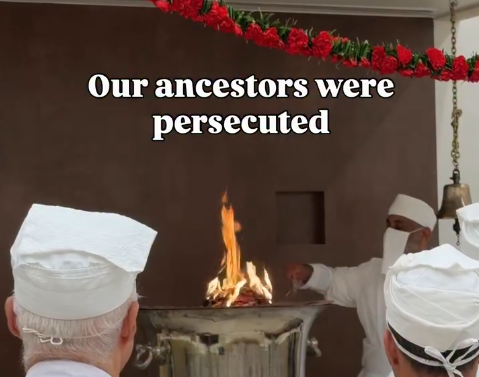
I love watching the Instagram videos produced by FEZANA. They range from witty and funny to serious, but are generally upbeat, or sometimes factual. Recently, however, they produced one that was not easy to take.
It is a hopeful message, but something in the video struck a chord and brought me down. I blame the music of the clip and its combination with the images. For some reason, the dagger (really: nīsh-e xanjar, نیش خنجر) went in deep—such is the constitution of the emotional Oriental. But it gets worse. I started reading the comments, which are mostly fine. Some are too nationalistic for my taste, some are too emotional, like me, and some are just beside the point. But then I came across this one:

By now you can guess what happened: I teared up. Something in this comment spoke to me, like the blade of a dagger, and as you can see, I made that heart red. It was only today that I realised it reminded me of that brief ‘Mithrandir, why the halfling?’ dialogue from The Hobbit film. In that scene, Gandalf explains that it is the ‘everyday deeds of ordinary folk that keeps [sic] the darkness at bay; simple acts of kindness and love’; that is what gives him courage, and he, the great wizard, also tears up. Lady Galadriel responds: ‘Do not be afraid, Mithrandir! You are not alone’. That is it. A simple blessing in that comment and the reassurance that ‘they’, meaning ‘we’, are no longer alone. Not much more is needed. That reassurance is a powerful message.
For us Iranians, at least those I know, life is currently difficult, and we often crumble when someone is kind or simply puts a hand on our shoulder to show that they understand.
I had forgotten the exact words of the comment, yet today I realised that the whole encounter, the lingering on that clip and finding those words, somehow reminded me of a poem by Hafez:
در خرابات مغان نور خدا میبینم
این عجب بین که چه نوری ز کجا میبینم
In the tavern of the Magi, I see the light of God;
Behold this marvel: what a light I see, and from where!
جلوه بر من مفروش ای ملکالحاج که تو
خانه میبینی و من خانه خدا میبینم
Do not boast of your status to me, O king of the pilgrims; for you,
see the house, whilst I see God in the house.
دوستان عیب نظربازی حافظ مکنید
که من او را ز محبان شما میبینم
Friends! Do not fault Hafez for his amorous gaze;
for I see him as one of your devotees.
I know! It is just a comment by a random guy on the internet. It feels meaningless, and it probably is: just another Oriental, a certain ‘xerxes19.82’, reacting emotionally to a clip. Yet maybe not. Perhaps it is in that space of no meaning and pure emotion that a seed of hope can germinate. And if you are perplexed by these reflections and reactions, ideally widimušt ‘astonished’, then perhaps Molana has the answer. You and I have not had the same wine, nor the same level of intoxication:
شما مست نگشتید وزآن باده نخوردید
چه دانید، چه دانید، که ما در چه شکاریم؟
You have not become intoxicated, nor did you drink from that wine
What do you know? What do you know of what we are pursuing?
Still! I take the clip, its caption, the message, and the many comments left—even those that are beside the point—and remember, not for the first time, the words of Iqbal Lahori:
گمان مبر که به پایان رسید کار مغان
هزار بادهی ناخورده در رگ تاک است
Do not believe that the affair of the Magi has come to an end!
A thousand untasted wines still remain in the veins of the vine!
به خود خزیده و محکم چو کوهساران زی
چو خس مزی که هوا تیز و شعله بیباک است
Live withdrawn into yourself and firm like the mountains!
Do not live like straw, for the wind is sharp and the flame fearless.
Leave a Reply
You must be logged in to post a comment.