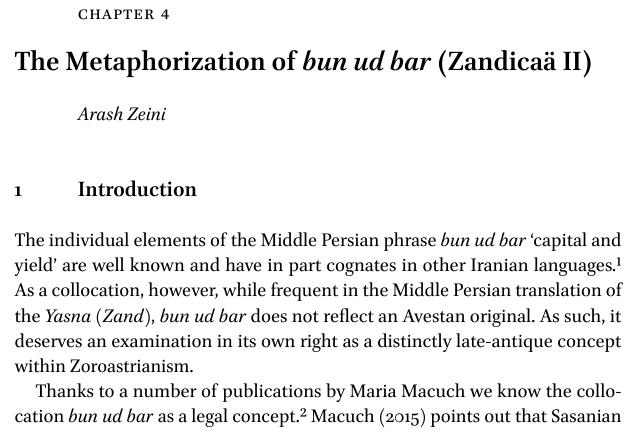
My latest paper, part of a series of articles on the concept of bun ud bar in late antique Zoroastrianism, has now been published:
Zeini, Arash. 2026. The metaphorization of bun ud bar (Zandicaä II). In Kianoosh Rezania, Neda Mohtashami & Yusef Saadat (eds.), The final frontier: Unveiling the ancient Iranian language of eschatology (Dynamics in the History of Religions 18), 140–170. Leiden: Brill.
The Middle Persian phrase bun ud bar, often translated as ‘capital and yield,’ or similar, is well known as a legal and theological concept within late-antique Zoroastrianism. As a coordinated and conceptual collocation, the phrase itself has no known parallels outside Middle Persian literature, while its constituent parts, bun and bar, are known in various other languages and play diverse roles across the corpus. The expression, however, has hitherto not been examined as a metaphor. This contribution reframes the collocation, boldly proposing the moment when the phrase morphs from an expression into a metaphor. Considered through the lens of Conceptual Metaphor Theory, the hypothesis is advanced that bun ud bar originated in legal discourse, was subsequently adopted in theological contexts, and ultimately became integrated into Sasanian administrative structures, or even political thought.
Abstract
Leave a Reply
You must be logged in to post a comment.