Stolper, Matthew & Michael Fisher. 2015. Achaemenid administrative tablets 3: Fragments from Old Kandahar, Afghanistan. ARTA: Achaemenid Research on Texts and Archaeology 1. 1–27.
Category: Publications
The Babylonian version of the Achaemenid inscriptions
Daneshmand, Parsa. 2015. New phraseology and literary style in the Babylonian version of the Achaemenid inscriptions. In Alfonso Archi (ed.), Tradition and innovation in the Ancient Near East: Proceedings of the 57th Rencontre Assyriologique Internationale at Rome 4–8 July 2011. Indiana: Eisenbrauns.
Farāmarz, the Sistāni hero
 van Zutphen, Marjolijn. 2014. Farāmarz, the Sistāni hero: Texts and traditions of the Farāmarznāme and the Persian epic cycle. Leiden/Boston: Brill.
In Farāmarz, the Sistāni Hero Marjolijn van Zutphen discusses the manuscripts, storylines and main themes of the shorter and the longer Farāmarznāme (c. 1100), in relation to Ferdowsi’s Shāhnāme and several other later maṡnawis about the warriors from Sistān (the Persian Epic Cycle). Farāmarz, a secondary figure of the Shāhnāme, gained importance in later epic traditions and as the invincible protagonist of both Farāmarznāmes reached a status that equalled, if not surpassed, that of his famous father Rostam.
A cultural history of Aramaic
 Gzella, Holger. 2015. A cultural history of Aramaic: From the beginnings to the advent of Islam. Leiden/Boston: Brill.
Aramaic is a constant thread running through the various civilizations of the Near East, ancient and modern, from 1000 BCE to the present, and has been the language of small principalities, world empires, and a fair share of the Jewish-Christian tradition. Holger Gzella describes its cultural and linguistic history as a continuous evolution from its beginnings to the advent of Islam. For the first time the individual phases of the language, their socio-historical underpinnings, and the textual sources are discussed comprehensively in light of the latest linguistic and historical research and with ample attention to scribal traditions, multilingualism, and language as a marker of cultural self-awareness. Many new observations on Aramaic are thereby integrated into a coherent historical framework
A hoard from the time of Yazdgard III in Kirmān
 An important article by Heidemann, Riederer and Weber on a hoard of coins from the final years of the empire. I personally find the dipinti on the coins very interesting. Heidemann’s discussion of the hoard, his conclusions and Dieter Weber’s decipherment of the graffito are fascinating:
Read the article here.
Early equids at Susa
Potts, Daniel. 2014. On some early equids at Susa. In B. Cerasetti (ed.), ‘My life is like the summer rose’ Maurizio Tosi e l’Archeologia come modo di vivere. Papers in honour of Maurizio Tosi for his 70th birthday (BAR International Series 2690), 643–647. Oxford: Archaeopress.
Read the article here.
Eschatological seers
Agostini, Domenico. 2014. Eschatological seers and otherworldly travellers in Zoroastrianism. Journal Asiatique 302(1). 47–73.
Sogdian bibliography
Benkato, Adam. 2015. Sogdian Bibliography.
This provisional bibliography restricts itself to works focused mostly on the Sogdian language and its linguistic analysis or editions of texts. Comments, corrections, and further entries are most welcome.Abraham and Nimrod
Kiel, Yishai. 2015. Abraham and Nimrod in the shadow of Zarathustra. Journal of Religion 95(1). 35–50.
Comparative Oriental manuscript studies

Bausi, Alessandro & Pier Giorgio Borbone, Françoise Briquel-Chatonnet, Paola Buzi, Jost Gippert, Caroline Macé, Marilena Maniaci, Zisis Melissakis, Laura Parodi, Witold Witakowski (eds.). 2015. Comparative Oriental manuscript studies: An introduction. COMSt.
The present introductory handbook on comparative oriental manuscript studies is the main achievement of the Research Networking Programme ‘Comparative Oriental Manuscript Studies’ (COMSt), funded by the European Science Foundation from June 2009 to May 2014. Within the framework of the five-year programme, several hundred scholars from ‘central’ as well as ‘marginal’ fields related to manuscript study and research had the opportunity ofexchanging ideas and discussing diverse approaches, looking for common ground and a better understanding of the others’ reasons and methodology in manuscript studies: from codicology to palaeography, from textual criticism andscholarly editing to cataloguing as well as conservation and preservation issues, and always taking into account theincreasing importance of digital scholarship and the natural sciences.
Alberto Cantera and Desmond Durkin-Meisterernst discuss in this volume Zoroastrian manuscripts and the Turfan fragments.
A new king of Susa and Anshan
An important article by Daneshmand and Abdoli about a previously unidentified Elamite king:
Daneshmand, Parsa & Meysam Abdoli. 2015. A new king of Susa and Anshan. Cuneiform Digital Library Bulletin 2015:1.

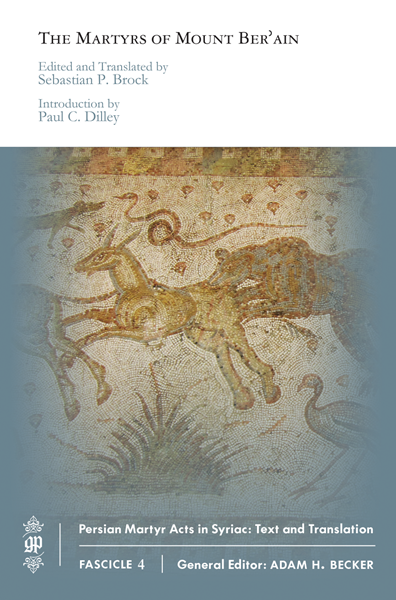
The martyrs of Mount Ber’ain
Brock, Sebastian. 2014. The Martyrs of Mount Ber’ain (Persian Martyr Acts in Syriac: Text and Translation 4). Gorgias Press. With an introduction by Paul C. Dilley.
The Martyrs of Mount Ber’ain is the poignant tale of an Iranian nobleman’s three children, Adarparwa, Mihrnarse, and Mahdukht, who embrace Christianity after the youngest brother’s near-death vision of God. This decision estranges them from their disbelieving father and ultimately results in death at the hands of King Shapur II. Gabriel “the Cow,” abbot of the monastery of Beth ‘Abe, composed the account of these events in the middle of the seventh century.
The Martyrs of Mount Ber’ain provides important evidence for enduring concerns of Christian self-definition in the framework of the Sasanian Empire, especially as represented by the Zoroastrian priesthood. The three children, Adarparwa, Mihrnarse, and Mahdukht, work to forget their education by the Magi, with whom they soon find themselves engaged in battle; and yet some key features of the narrative, especially Mihrnarse’s vision, reflect shared idioms between Christians and their Zoroastrian rivals. This rivalry was committed to writing and commemorated even after the Arab conquest, and one of these three sibling-martyrs, the sister Sultana Mahdukht, is still memorialized in both Iraq and the United States.
OverviewThe blessed Simeon bar Sabba’e
 Smith, Kyle. 2014. The martyrdom and history of blessed Simeon bar Sabba’e (Persian Martyr Acts in Syriac: Text and Translation 3). Gorgias Press.
Around the year 339 CE, Simeon bar Sabbae (the bishop of Seleucia-Ctesiphon on the Tigris) was killed by the Persian king Shapur II. Simeon was arrested for refusing to collect taxes from his flock, and he was beheaded for disobeying the king’s order to worship the sun. The bishop of Seleucia-Ctesiphon was no minor figure. In fact, Simeon’s martyr acts proclaim that he was the leader of the Christians of Persia and the protomartyr of Shapur’s forty-year persecution. Curiously, however, two very different versions of Simeon’s death exist. Each is presented here with an accompanying translation and notes.
Simeon’s Martyrdom and History are fundamental sources for chronicling the history of Christianity in Sasanian Persia. Together, these texts testify to the centrality of martyrdom literature in late ancient Syriac Christianity, and they show how Persian Christians forged their own political and religious identities amidst the ongoing Christianization of the Roman Empire.
The story of Mar Pinhas
 McCollum, Adam Carter. 2013. The story of Mar Pinhas (Persian Martyr Acts in Syriac: Text and Translation 2). Gorgias Press.
 van Zutphen, Marjolijn. 2014.
  Gzella, Holger. 2015.
  An important article by Heidemann, Riederer and Weber on a hoard of coins from the final years of the empire. I personally find the dipinti on the coins very interesting. Heidemann’s discussion of the hoard, his conclusions and Dieter Weber’s decipherment of the graffito are fascinating:
 Smith, Kyle. 2014.
  McCollum, Adam Carter. 2013.