I have a new article in a volume I edited with Adam Benkato for the Journal of the Royal Asiatic Society. More details on the volume will follow soon, but my article is already available on the Journal’s FirstView:
This article examines the extent of the concluding section (Y 41) of the Yasna Haptaŋhāiti in light of the manuscript evidence and the section’s divergent reception in a Middle Persian text known as the “Supplementary Texts to the Šāyest nē Šāyest” (Suppl.ŠnŠ). This investigation will entertain the possibility of an alternative ritual being described in the Suppl.ŠnŠ. Moreover, it argues that the manuscripts transmit the ritual text along with certain variations and repetitions while the descriptions of the extent of each section preserve the necessary boundaries of the text as a textual composition or unit.
چندی پیش در مطلبی کوتاه درباره زبانشناسی تاریخی، با عنوان «آیا ایرانیان آریایی هستند؟»، به پژوهشهای ژنتیک اشاره کردم. در ادامه آن نوشته این دو کتاب را با توجه به این که هر دو به ایران هم میپردازند، اینجا معرفی میکنم.
پژوهش در مورد ژنتیک، نژاد و دیانای باستانی ممکن است در ابتدا برای مطالعات ایرانشناسی و فعالیت ما در سایت BiblioIranica موضوعی فرعی به نظر برسد. اما نتایج این نوع مطالعات میتوانند نقش مهمی در درک بهتر ما از پرسشهای پیچیدهای مانند مهاجرت، رابطه خانوادههای زبانی و ملی گرایی ایرانی بازی کنند. دو کتاب زیر، این موضوعات را از دیدگاههای متفاوت مورد بحث قرار میدهند و هر دو در گوشه و کنار به ایران هم میپردازند.
The following text first appeared on the blog of the Edinburg University Press on 4 August 2020. The original is here. I am reproducing it here without any textual alterations except some minor formatting.
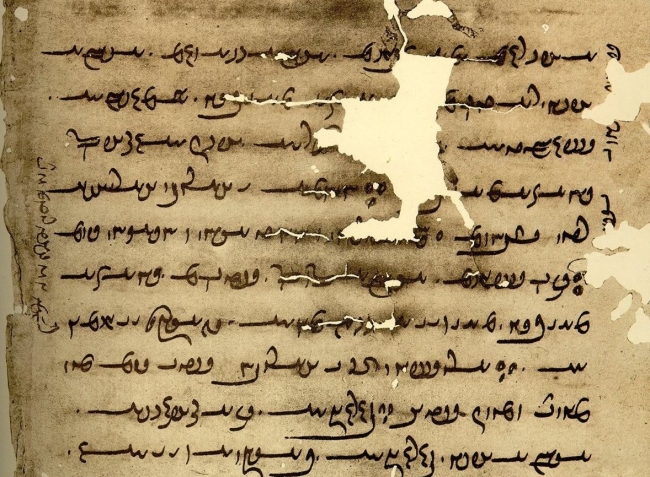
Y 35 in manuscript J2 (1323 CE)
On translation and exegesis in the Zoroastrian religious tradition
Zoroastrianism, now a minority faith in Iran and India, is an Iranian religion with a complex textual transmission reaching back to the remote antiquity.
The oldest layers of the surviving Zoroastrian texts are in Avestan language and commonly dated to the middle of the second millennium BCE. Exact dates and circumstances of composition, however, remain uncertain, so that little is known about the socio-political context from which these texts emerged. After two millennia of oral transmission, the texts were finally committed to writing, at a time when the language must have no longer been in active use.
Last week, I taught about Anquetil-Duperron, William Jones, the discovery of language similarity and the beginnings of IE Studies. Disciplines such as Iranian Studies or #Indology, as we know them today, would not have been possible without those efforts and contributions. I also made it a point to at least briefly discuss “genesis amnesia” and the critical examination of Oriental Studies offered by @tavak in
Some nifty and original observations by my Shervin Farridnejad on a passage in the Nērangestān, discussing the priestly duty concerning the care of xrafstars, commonly referred to as obnoxious creatures:
This book contains a critical edition of the Avestan language composition known as the Rašn Yašt, or ‘Hymn to Justice’. The text is accompanied by an English translation, philological commentary and glossary. In addition, the main themes of the Rašn Yašt are taken up for detailed discussion, covering the Zoroastrian deity Rašnu, ancient Iranian cosmography, and the use of ordeal rituals in pre-Islamic Iran.
This study seeks to gather and clarify the terminology for carpets used by peoples of Central Asia from about 300 BCE to 1000 CE time, including terms in Kharoṣṭhi, Khotanese, Sanskrit and its relatives, plus Persian, Sogdian, Chinese, and Turkic.